


Pastors of the Revolution: The “Black-Robed Regiment”

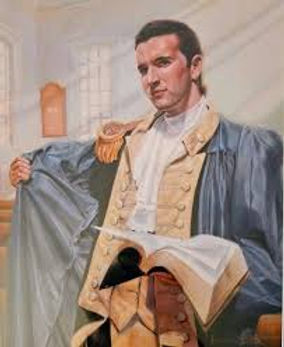
In colonial and Revolutionary America the church was a hub of community and political life, and many ministers used their pulpits to argue the patriot cause. So influential were these preachers that defenders of the Crown reportedly dubbed them the “Black-Robed Regiment,” after the black clerical robes they wore.¹ Whatever the exact origin of the nickname, the role of patriot clergy in shaping public opinion is well attested.
The most famous of these ministers was the Reverend John Peter Muhlenberg, a Lutheran pastor in Woodstock, Virginia. By tradition, in early 1776 he preached from Ecclesiastes 3 — “To every thing there is a season … a time of war, and a time of peace” — then declared that the time to fight had come, removed his clerical robe to reveal a Continental Army uniform beneath, and called for volunteers.² He helped raise the 8th Virginia Regiment, served through the war, wintered at Valley Forge, was present at the British surrender at Yorktown, and rose to the rank of major general.³ His statue stands today in the U.S. Capitol's Statuary Hall, clerical robe over one arm and sword in hand.²
Another was the Reverend James Caldwell, minister of the First Presbyterian Church of Elizabethtown, New Jersey. Having made enemies by his outspoken support of independence, he is said to have placed two loaded pistols on the pulpit as he preached, and the British called him the “Fighting Chaplain.”⁴ It was Caldwell who, at the Battle of Springfield in 1780, reportedly supplied his men with hymnal pages for musket wadding, shouting, “Give 'em Watts, boys!”⁴
These were not the only clergymen in the struggle. The Reverend Samuel West, a Congregationalist pastor in Dartmouth, Massachusetts, preached a famous 1776 election sermon defending the right of an oppressed people to throw off tyranny.⁵ And the Reverend John Witherspoon, Presbyterian minister and president of the College of New Jersey (later Princeton), was the only active clergyman to sign the Declaration of Independence.⁶
Some colorful sayings tied to this story — such as the claim that King George III called the conflict a “Presbyterian rebellion” — are widely repeated but are best treated as traditional rather than firmly documented, and we pass them along with that caution.¹ What is beyond doubt is that ministers of many denominations preached, organized, and in some cases fought for the patriot cause, persuading hesitant congregations that resistance could be a sacred duty.¹
SOURCES
1. “The Black-Robed Regiment: Preachers Who Fought,” Freedom Education Foundation.
2. “The Black Robe Regiment” / “Rev. Peter Muhlenberg,” Kelly Goshorn (Romancing History).
3. Muhlenberg's service record (8th Virginia, Valley Forge, Yorktown); ibid.
4. “Pastors, Patriots, & the Black Robe Regiment,” on James Caldwell.
5. Reverend Samuel West, 1776 Election Day sermon; ibid.
6. “Christianity and the American Revolution,” on John Witherspoon as signer.