


The Boston Tea Party

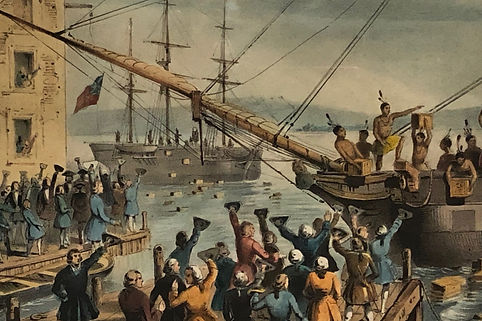
On the night of December 16, 1773, American colonists boarded three merchant ships at Griffin's Wharf in Boston Harbor and threw 342 chests of British East India Company tea into the water.¹ It was the boldest act of defiance yet against British rule, and a direct protest against “taxation without representation.”¹
The crisis had been building since Parliament passed the Tea Act of 1773, which granted the struggling East India Company a monopoly on tea sold in the colonies and let it undercut local merchants while still requiring colonists to pay a tax.² In most port cities, tea agents resigned and ships were turned away. In Boston, however, the royal governor, Thomas Hutchinson, refused to let the tea ships — the Dartmouth, the Eleanor, and the Beaver — leave the harbor without unloading their cargo and paying the duty.³
The decisive gathering took place in a house of worship. On December 16, thousands of Bostonians crowded into the Old South Meeting House, where they learned that Hutchinson had again refused to let the ships depart.⁴ When no compromise could be reached, the assembly broke up, and that evening a body of men — many of them members of the Sons of Liberty, some disguised as Mohawk Indians — marched to the wharf.¹
What followed was strikingly orderly. The men pried open the chests with axes and dumped roughly 92,000 pounds of tea into the harbor, taking care to damage nothing else. When a padlock was accidentally broken, the participants later replaced it, and accounts agree that no other property was harmed and no tea was stolen.⁵ The estimated value destroyed was about £18,000 — on the order of well over a million dollars today.⁶
The reaction was swift. John Adams, who admired the protest's discipline, called it in his diary “the most magnificent Movement of all.”⁴ Britain answered with the Coercive Acts — known in the colonies as the Intolerable Acts — which closed the port of Boston and tightened royal control. Those measures drove the colonies to convene the First Continental Congress in 1774, and within two years independence was declared.² That the whole drama turned on a mass meeting inside the Old South Meeting House is a fitting reminder of how central the colonial church and meeting house were to public life.
SOURCES
1. “Boston Tea Party – Definition, Dates & Facts,” HISTORY.
2. “Boston Tea Party,” Encyclopaedia Britannica.
3. “The Boston Tea Party,” Digital Public Library of America (DPLA).
4. “250th Anniversary of the Boston Tea Party,” James Monroe Museum (Adams diary quotation).
5. “The Boston Tea Party,” American Battlefield Trust; National Park Service timeline.
6. U.S. Census Bureau history feature, December 2023 (value of tea).