


Hymns and Sacred Song in the Revolution

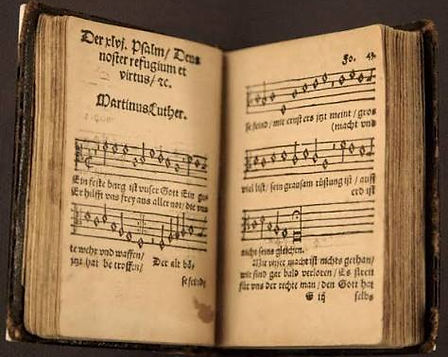
Music in colonial America was overwhelmingly sacred music. In the meeting houses of New England, the singing of psalms was a central part of both worship and community gatherings, and it was from this tradition that the nation's first homegrown music — and one of the Revolution's earliest anthems — emerged.¹
The pivotal figure was William Billings (1746–1800) of Boston, a tanner by trade and largely self-taught, regarded as the first American choral composer.² In 1770 he published The New-England Psalm-Singer, the first collection of music composed entirely by an American, with a frontispiece engraved by his friend Paul Revere.³ Billings led singing schools and trained choirs in prominent Boston congregations, including the Brattle Street Church and the Old South Church, and he is credited with helping introduce the pitch pipe and the bass viol to steady the singing in Puritan churches that had used no instruments.⁴
Billings's best-known work is the hymn tune “Chester.” He first published it in 1770 and revised it for his 1778 collection The Singing Master's Assistant, adding the stirring opening line, “Let tyrants shake their iron rod, / And slav'ry clank her galling chains; / We fear them not, we trust in God; / New England's God forever reigns.”⁵ Billings wrote both the words and the music himself.⁶
Set to a fiery, martial tune, “Chester” became immensely popular among the Patriots — sung in camp and on the march, it is often described as the unofficial anthem of the Revolution, rivaled in popularity only by “Yankee Doodle.”⁶ Unlike the later “Star-Spangled Banner,” whose melody came from an English song, both the words and tune of “Chester” were American.⁶
Hymns also served the cause in a more startling way. When the men of the Reverend James Caldwell's New Jersey militia ran short of the paper wadding needed to load their muskets at the Battle of Springfield in 1780, Caldwell is said to have rushed to a nearby church, gathered hymnals by the great hymn-writer Isaac Watts, and handed out the pages with the cry, “Give 'em Watts, boys!”⁷ Whether on the lips of marching soldiers or torn into musket cartridges, the sacred song of the colonial church accompanied Americans into the fight for independence.
SOURCES
1. “Eccentric Hymn Composer William Billings,” Christianity.com.
2. “William Billings,” Songwriters Hall of Fame.
3. “William Billings,” Encyclopedia.com (Brattle Street and Old South churches).
4. “William Billings and ‘Chester,’” Walker Homeschool Blog.
5. “Chester (song),” Wikipedia.
6. “Chester,” What So Proudly We Hail (authorship of words and tune).
7. Account of James Caldwell, “Give 'em Watts,” Battle of Springfield; Black Robed Regiment sources (see Article 9).