


The Betsy Ross Flag: Legend and History

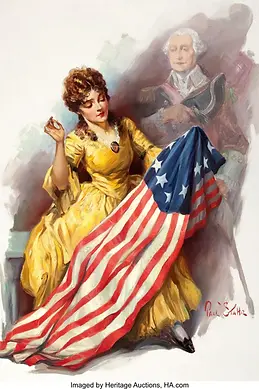
The story is familiar to nearly every American schoolchild. As it is told, in June 1776 a small committee of the Continental Congress — George Washington, Robert Morris, and George Ross — called on a Philadelphia upholsterer named Elizabeth “Betsy” Ross and asked her to sew a flag for the new nation. Washington showed her a sketch with thirteen stripes and thirteen six-pointed stars; Betsy suggested a five-pointed star instead, showing how she could cut one with a single snip of her scissors, and the committee agreed.¹
Betsy Ross was a real person and a genuine flag maker. Born Elizabeth Griscom on January 1, 1752, into a large Quaker family, she learned to sew, apprenticed to an upholsterer, and ran her own shop.² The documentary record confirms that she made flags for the Pennsylvania State Navy Board in 1777 — she was, beyond question, a working flag maker during the Revolution.³
What cannot be confirmed is the famous “first flag” encounter. The story did not become public until 1870, when Betsy's grandson, William Canby, presented it in a paper to the Historical Society of Pennsylvania — nearly a century after the supposed 1776 visit.⁴ Canby based his account on family memories and on what he said his grandmother had told relatives; he and other family members later signed affidavits, but he could produce no contemporary document, letter, or government record to support the tale.⁵
Historians note that George Washington's surviving papers, though they show a keen interest in flags, never mention a visit to Betsy Ross's shop.⁶ Many scholars credit Francis Hopkinson, a signer of the Declaration and a designer of the Great Seal, with a leading role in the early flag's design.⁶ There are, however, suggestive connections: George Ross, named in the story, was the uncle of Betsy's late husband, John Ross — which could help explain why she might have been approached.¹
We can say, then, that the Betsy Ross flag — thirteen red and white stripes with thirteen stars in a circle, the ring symbolizing the equality of the colonies — is one of the most cherished emblems of the founding era, and that Betsy Ross herself truly made flags for the patriot cause. The specific claim that she sewed the very first Stars and Stripes is best described, as historians generally do, as a treasured American legend rather than an established fact.⁷
SOURCES
1. “Did She or Didn't She?” Historic Philadelphia, Inc., 2025.
2. “The Betsy Ross Flag: History, Meaning, and the Real Story,” Proud & Free, 2026.
3. Records of flags made for the Pennsylvania State Navy Board, 1777; ibid.
4. “Betsy Ross,” Encyclopaedia Britannica, 2026.
5. “The Betsy Ross Flag Controversy Explained,” Newsweek, 2021.
6. “Betsy Ross,” Pennsylvania Center for the Book.
7. “The Betsy Ross Museum,” Wonderful Museums, 2025.