


Bibles of the Revolution: The Aitken Bible of 1782

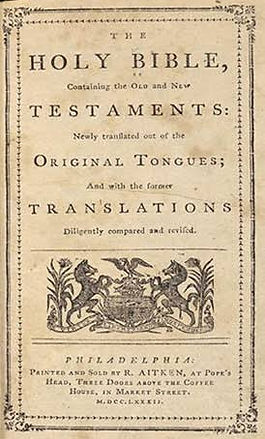
Before the Revolution, English-language Bibles could not be legally printed in the American colonies. The British government regulated their publication, and every English Bible had to bear the imprint of the Crown, so colonists imported them from Britain or Europe.¹ Bibles in other languages were printed in America — including John Eliot's Bible of 1661–1663 in the Massachusetts Indian language — but not in English.²
The war severed that supply. Trade with Britain was cut off, and a serious shortage of Bibles followed.¹ As early as 1777 a committee of the Continental Congress reported that the proper type and paper for printing a Bible could not be obtained in the country, and judged the shortage a grave matter because “the use of the Bible is so universal, and its importance so great.”³
Into this need stepped Robert Aitken, a bookseller and printer who had emigrated from Scotland to Philadelphia in 1769. In 1781 he petitioned Congress to support his plan to print an English Bible in America.⁴ Congress did not give him money or agree to buy copies, but after a committee reviewed the work, it issued a formal endorsement in September 1782, approving “the pious and laudable undertaking of Mr. Aitken.”⁵
The result, completed in 1782, was the first complete English-language Bible printed in North America — and the only Bible printing ever authorized by an act of the United States Congress.⁶ It was a small volume, compact enough to fit in a coat pocket, and it has come to be known as “the Bible of the Revolution.”⁴ A point of historical precision: the body that approved it was the Congress of the Confederation, governing under the Articles of Confederation.⁶
The Aitken Bible stands as a vivid reminder of how closely Scripture was woven into the life of the founding generation. Original copies are preserved today in institutions such as the Library of Congress and the Museum of the Bible, and facsimile editions keep its memory alive.⁶ For a congregation looking back on the Revolution, it offers a tangible link between the nation's birth and the Word that so many of its people treasured.
SOURCES
1. “The Aitken Bible,” Museum of the Bible (collections.museumofthebible.org).
2. “The Aitken Bible and Congress,” WallBuilders (on the Eliot Bible and Crown licensing).
3. Tara Ross / Continental Congress committee report of 1777, quoted in Anglophilic Anglican.
4. “AITKEN BIBLE – 1782 A.D.,” Library of the Bible.
5. “Aitken Bible,” The First Amendment Encyclopedia (text of the 1782 resolution).
6. “‘Bible of the Revolution’: the Aitken Bible,” Library of Congress blog, 2023.