


The Midnight Ride of Sybil Ludington

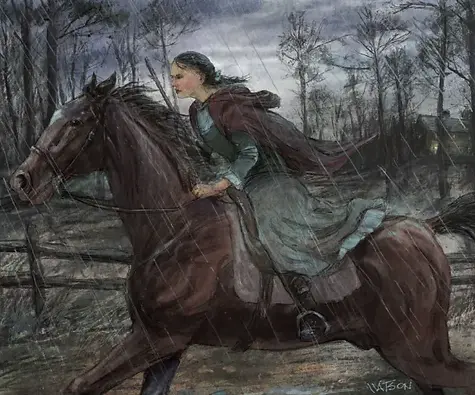
According to a story passed down through the Ludington family, on the night of April 26, 1777, sixteen-year-old Sybil Ludington mounted her horse and rode some forty miles through the rain-soaked countryside of Putnam County, New York, to rouse her father's militia.¹ Her father, Colonel Henry Ludington, commanded a regiment of local farmers who, that planting season, were scattered across their fields and homes on furlough.²
The alarm came when an exhausted messenger reached the Ludington farmhouse with word that British troops under General William Tryon had landed on the Connecticut coast, marched inland, and were burning Danbury — the site of a major Continental Army supply depot.² The colonel needed to organize his men as they arrived, and the messenger was too spent to ride on. As the family tradition tells it, Sybil volunteered to carry the warning herself.²
Her father's militia did not assemble in time to save Danbury or to reach the fighting at Ridgefield on April 27, but the gathered men did harass the British column as it retreated toward Long Island Sound.³ For her ride, Sybil has long been honored as a kind of “female Paul Revere,” commemorated on a United States postage stamp and with a statue near Lake Gleneida in Carmel, New York.⁴
Honesty about the sources matters here, and we offer it plainly. No contemporary record from 1777 — no militia log, diary, or letter written at the time — mentions the ride.⁵ The earliest known reference is an 1854 letter from Sybil's nephew, and the story did not appear in print until 1880, more than a century after the alleged event, in a local history by Martha Lamb.⁶ A fuller account followed in a 1907 biography of her father.⁵ Because of this gap, a number of historians have questioned whether the ride happened as told, or at all, and even the spelling of her name varies across records.⁷
The underlying events are firmly documented: the British did burn Danbury in April 1777, and night riders did raise the alarm that brought New York and Connecticut militia into the field.⁷ What rests on family memory rather than period documentation is Sybil's specific role. We share the story as it has been handed down, while noting clearly where the evidence ends and tradition begins — a distinction worth keeping for any tale we hold dear.
SOURCES
1. “Sybil Ludington,” Wikipedia, accessed 2026.
2. “Sybil Ludington: The Teenage Patriot,” Civics for Life, May 2026.
3. “Sybil Ludington: Unsung Heroine of the American Revolutionary War,” Ancient Origins, 2021.
4. “Retrace Sybil Ludington's Legendary Ride,” The Journal News / AOL.
5. Paula D. Hunt, study in The New England Quarterly, cited in Explore the Archive, 2018.
6. “Sybil Ludington was called the ‘female Paul Revere.’ But did her ride really happen?” Spectrum News, June 2026.
7. “Did the Midnight Ride of Sibyl Ludington Ever Happen?” Smithsonian Magazine, March 2022.